Startup of the Day: Physicl – Generating Photorealistic Synthetic Worlds for Physical AI and Robotics (2026-11-06)
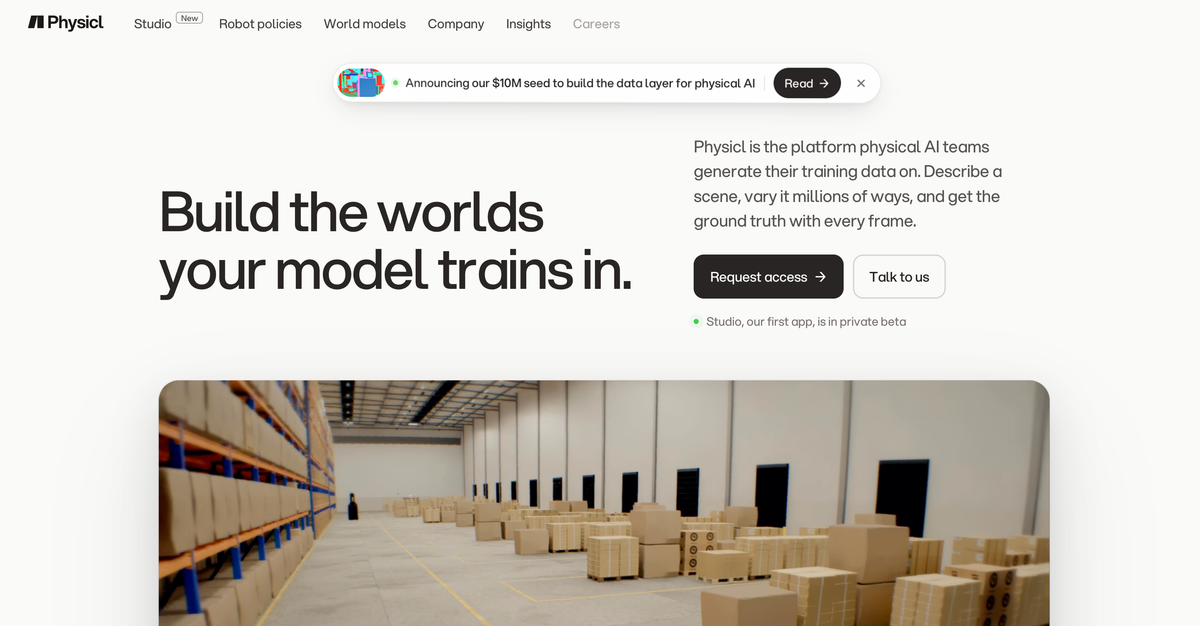
Physicl raises a $10M Seed round led by Inovia Capital to bridge the sim-to-real gap in physical AI, providing pixel-perfect synthetic 3D worlds for robotics training.
Executive Impact Briefing
The Big Picture: As artificial intelligence transitions from language models into embodied agents and robotics, Physicl is emerging as the critical data factory solving the acute physical data shortage by procedurally generating millimeter-accurate synthetic 3D environments.
30-Second Summary & Key Takeaways
- Venture Round & Lead Investor: Closed a $10,000,000 Seed funding round led by Inovia Capital, bringing premier institutional backing to its synthetic data generation platform.
- Pioneering Leadership & Advisory Bench: Founded by Alexandre de Vigan (former founder & CEO of 3D e-commerce pioneer nfinite), advised by luminaries from Hugging Face, World Labs, Adobe Substance, Meta Reality Labs, and TUM.
- Proprietary Technology Moat: Physicl Studio integrates over 10,000 interactive 3D environments and 100,000 physically grounded assets, delivering automated ground-truth annotations across metric depth, normals, segmentation, and 6-DoF camera poses.
The Core Breakthrough
The artificial intelligence ecosystem has reached an inflection point. While text and multi-modal digital agents thrive on vast web-scale scrapes, physical AI—spanning autonomous mobile robots, humanoid manipulators, industrial warehouse automation, and autonomous vehicles—faces a crippling data bottleneck known as the "sim-to-real gap."
Collecting physical training data through teleoperation or real-world sensor rigs is fundamentally slow, dangerous, and prohibitively expensive. Moreover, passive 2D video repositories lack depth information, metric scale, and physical priors. When robotic foundation models are trained purely on passive recordings, they struggle to generalize when confronted with novel lighting angles, unexpected clutter, or reflective surfaces.
Physicl tackles this structural deficit by repurposing high-fidelity, procedural 3D computer graphics pipelines into an automated synthetic training ground. Rather than capturing static video footage that cannot be modified, Physicl enables robotics and AI engineering teams to generate fully customizable, interactive 3D simulations where every single rendered frame contains exact physical ground truth.
In Plain English: Teaching a robot how to navigate a messy warehouse in real life is like teaching someone to drive by only letting them crash real cars in expensive parking lots. Physicl builds an infinite, photorealistic flight simulator where robots can practice millions of challenging scenarios overnight without breaking a single physical machine.
Real-World Impact: Robotics manufacturers, autonomous vehicle developers, and spatial computing labs can slash their physical data collection budgets by up to 80% while training their policies against rare edge cases before deploying to physical hardware.
Technology Moat & Technical Architecture
At the center of Physicl's product offering is Physicl Studio, a specialized synthetic data platform designed specifically for the rigorous demands of embodied AI foundation models. Built on procedural 3D generation and ray-traced rendering pipelines, the system delivers several structural advantages over legacy simulators:
- Deterministic Multi-Modal Annotation Pipeline: For every frame synthesized within Physicl Studio, the rendering engine exports synchronized, pixel-aligned ground-truth metadata layers. These include 32-bit metric depth maps (in EXR format), surface normal vectors, semantic and instance segmentation masks, 2D and 3D bounding boxes, and millimeter-accurate 6-DoF camera poses. Details on their data pipelines are documented on the official Physicl Platform.
- Scalable Asset & Environment Repository: Launching with over 10,000 pre-indexed interactive 3D environments (including complex logistics hubs, manufacturing floors, retail spaces, and domestic interiors) and more than 100,000 physically grounded 3D objects, the platform allows engineering teams to populate rich, photorealistic spaces instantly.
- Closed-Loop Synthetic Augmentation: Rather than relying on static benchmark datasets, developers can parameterize environment properties along critical operational axes. Teams can programmatically adjust sun positioning from morning glare to pitch-black nighttime, dial up floor reflectivity, introduce dust or fog artifacts, and vary clutter densities to stress-test vision-language-action (VLA) models against severe distribution shifts.
- Agentic Data Generation API: Physicl is engineered to integrate directly into active foundation model training loops. When an embodied agent fails a specific manipulation or navigation benchmark during evaluation, the API can programmatically synthesize a targeted curriculum of 50,000 custom edge-case scenarios to reinforce the model's operational policy.
For additional coverage of the technology and company milestones, consult the official TechCrunch Announcement.
Financials & Capitalization
Physicl publicly announced its $10,000,000 Seed financing round on November 6, 2026. The round was led by Inovia Capital, a tier-one venture firm with a track record of backing foundational enterprise software and spatial computing platforms.
The company's capitalization is further distinguished by an elite coalition of industry advisors and angel investors representing the frontier of generative graphics and artificial intelligence:
- Alexandre de Vigan: Founder & CEO, bringing deep domain leadership from scaling 3D e-commerce visualization platform nfinite.
- Thomas Wolf: Co-founder of Hugging Face, advising on open-source machine learning distribution and dataset standardization.
- Christoph Lassner: Co-founder of World Labs, contributing state-of-the-art expertise in generative world models.
- Sébastien Deguy: Founder of Allegorithmic and creator of Adobe Substance, guiding procedural 3D texturing and material science.
- Yaser Sheikh: Head of Codec Avatars at Meta Reality Labs, lending decades of spatial perception and volumetric capture mastery.
- Matthias Niessner: Professor of Robotics at the Technical University of Munich (TUM) and CEO of SpAItial, driving computer vision research.
Competitive Moat & Market Threat
Physicl enters a high-stakes arena where simulation software and foundation model providers are racing to capture the physical AI value chain:
- Industrial Simulation Giants (NVIDIA Isaac Sim / Omniverse): NVIDIA maintains an extensive hardware-integrated footprint with Isaac Sim. However, Physicl differentiates itself through a lightweight, cloud-native Studio workflow that abstracts away complex simulation engineering, making procedural scene generation accessible via simple API calls and visual interfaces.
- Academic Physics Engines (MuJoCo, Drake, Genesis): While classical open-source physics engines excel at rigid-body dynamics, they often lack the photorealistic graphical fidelity and dense semantic annotation layers required to train robust visual perception networks. Physicl bridges photorealism with physical ground truth.
- Generative World Model Labs (World Labs, Physical Intelligence, Wayve): Generative video models can imagine physical environments, but frequently hallucinate physical laws, scale, and lighting consistency. Physicl relies on deterministic graphics pipelines, guaranteeing millimeter-accurate geometry and verifiable ground truth.
What to Watch Next (6–12 Month Horizon)
With $10M in fresh seed capital and headquarters across New York, San Francisco, and Paris, Physicl is positioned for rapid enterprise acceleration over the coming year:
- Private Beta Expansion: Transitioning Physicl Studio from invite-only researcher access into broader general availability for commercial robotics teams and industrial automation integrators.
- Standardized Embodied AI Benchmarks: Rolling out native integrations for popular robotics frameworks (ROS 2, Isaac Lab, LeRobot), establishing standardized synthetic pre-training benchmarks.
- Core Engineering Expansion: Aggressively hiring graphics programmers, procedural technical artists, and simulation research scientists across its Paris and US engineering hubs.


